Sichuan Spicy Hot Pot (麻辣火鍋)
Warning: Parameter 2 to wp_hide_post_Public::query_posts_join() expected to be a reference, value given in /home/yirese5/public_html/wp-includes/class-wp-hook.php on line 287
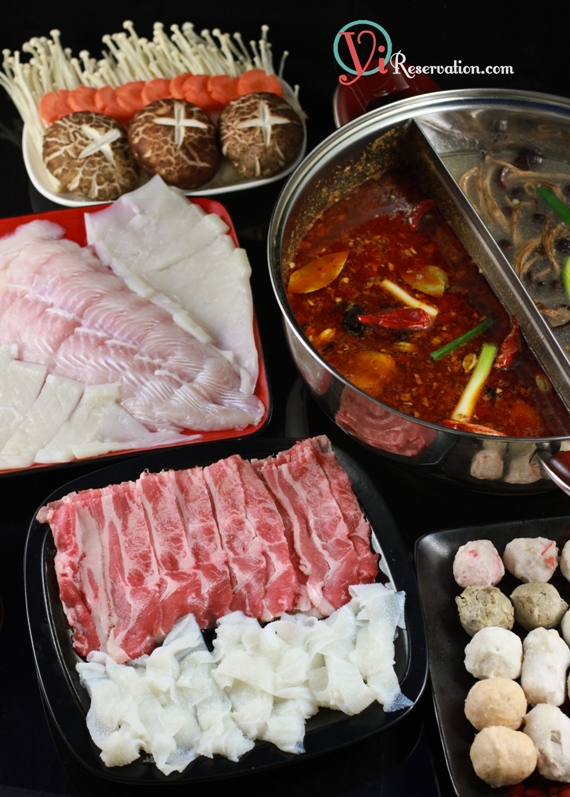
This is Part II of the Hot Pot Series. Here are the other posts in this series:
Part I – Introduction to Chinese Hot Pot
Part III – Clear Soup Hot Pot
Part IV – Quick and Easy Sichuan Spicy Hot Pot
In Part I of this Hot Pot Series, I talked about the origin and culture of this traditional Chinese communal meal. Today, I’d like to introduce you to my favorite type of hot pot: the famous Sichuan (Szechuan)Spicy Hot Pot.
As the name suggested, Sichuan hot pot was originated from Sichuan Province which is known for its appetite for spicy food. This mouth-burning and tongue-numbing hot pot has been gaining enormous amount of attention in recent years in the States. With Sichuan hot pot restaurants springing up in New York City, I figure I’d first give a brief history of this new sensation.
The commonly accepted theory traces the Sichuan Hot Pot back to early 20 century. At the time, the port workers and fishermen worked and lived along the Yangtze River could not afford to eat the regular cuts of meat so they figured out a way to cook cheap meats and offal by boiling them in a pot of extremely spicy broth. The use of spicy broth was first intended to disguise the faulty taste from the offal. However after some modification and addition of fragrant spices, this one pot meal became a popular dish in Sichuan region.
After years of continuous development, the Sichuan Hot Pot today is much more refined and no longer a meal for the lower-class. Although offal still remains as classic hot pot ingredients, high quality meats and seafood ingredients are also common on the menu. The modern hot pot has been shape into a progressive meal that starts with sliced meat, offal, and seafood followed by vegetables and ends with noodles.
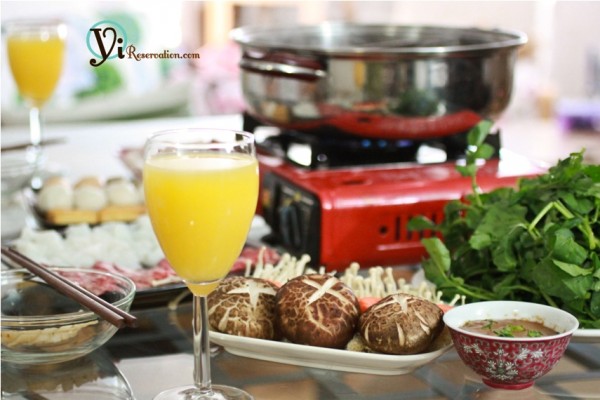
As I mentioned in part I of the series, eating hot pot is a slow and interactive meal. You poach your raw ingredients in the boiling broth and at the same time engage in a conversation with your friends and family. To that reason I prefer to prepare the meal at home.
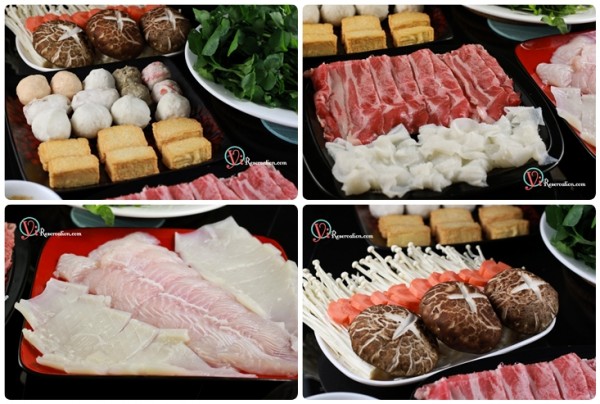
For a quick hot pot at home, I only include a handful of my favorite ingredients to save some prep time and avoid too much leftover. I like to do a combination of red meat, meat ball, fish, squid, mushrooms, and green vegetables. You can find a list of common ingredients in my hot pot introduction article.
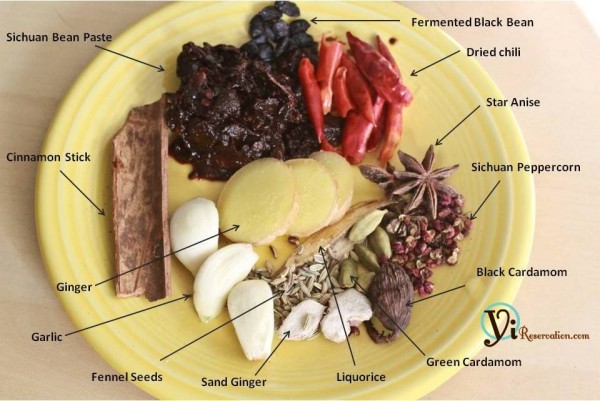
There are pre-made mix packages you can buy at Asian grocery stores (use it if you really can’t do it from scratch) but I like to make my own spicy broth from scratch according to my own taste. I know it might sound crazy but it’s really not that bad plus you can do thing in bulk for multiple uses. Here are some of the ingredients and condiments needed to make the Sichuan spicy hot pot broth:
Step-by-step instruction:
Yield: 1/2 12" special pot
Prep Time: 30 mins
Cook Time: 120 mins
Total Time: 150 mins
Ingredients:
Aged-spicy paste (adjust to your own spiciness)
- 3 tbsp Sichuan Spicy Bean Paste
- 5 Dried chili, soaked until soft.
- 1 tbsp Chinese Black Bean
- 4 slice Ginger, 4 glove Garlic
- ½ cup Cooking Wine
- 1tbsp Rock Sugar
For the stock
- 2 lb Beef or Pork or Chicken bones
- 3 slice Ginger
- 2 Scallion
- 3 Bay leaf
- 1 gallon water
Directions:
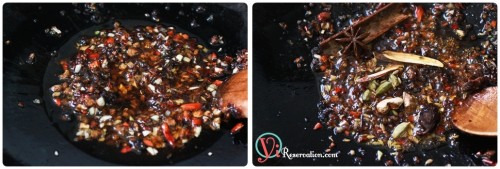
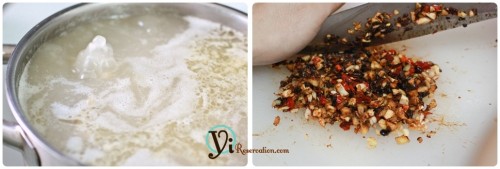 Combine 4 tbsp of oil and all the chopped ingredients, cook in low heat for 10 minutes. Stir frequently. Add the rest of the dry spices and cooking wine and sugar to the paste. Continue to cook in low heat for another 30 minutes then turn off the heat. This is your aged-spicy taste and can be made in advance.
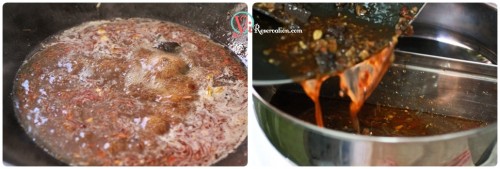
 Before serving the hot pot, combine the aged-spicy paste with base stock and bring to boil. Add additional ginger, dried chili, and salt to taste.
  To make the special peanut butter sesame dipping sauce, combine the peanut butter, sesame paste, and fermented bean curd. Mix into a paste. Add oyster sauce, sugar, chopped chive flower and mix well.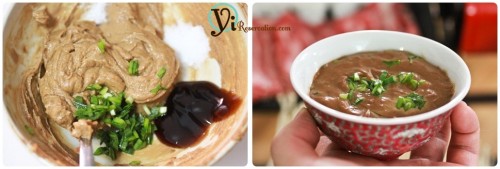
If in case you are curious about the broth on the non-spicy side, it’s made of tea tree mushroom and broth. Similar to this recipe here.
Chinese Hot Pot Equipment
The most common hot pot setup requires two pieces of equipment:
1) A single-burner tabletop stove powered by butane is normally used to serve the boiling pot. Make sure to choose a portable single- burner that can adjust the output.
2) Although any stainless steel pot can be used to serve the hot pot, I normally use a special pot with a divider in the middle so I can serve half spicy half non-spicy (known as 鸳鸯 in Chinese).
Alternatively, you can also go for an all-in-one electric setup, but I find this system lack of heat output (perhaps just the one system I have used)
On Eating the Hot Pot
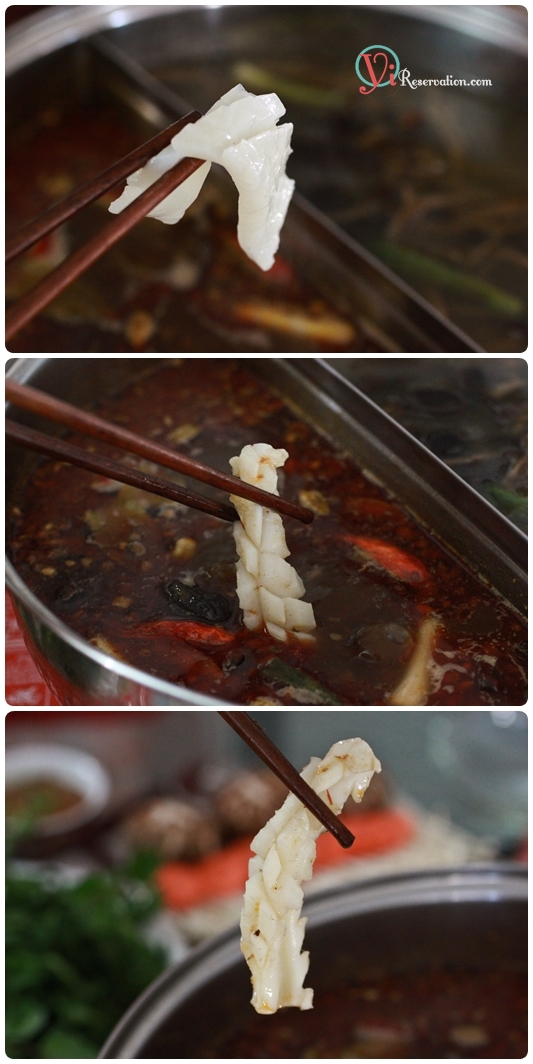
Here is a quick demonstration on how to hot pot a piece of raw squid: pick up the squid with your chopsticks –> submerge it in the boiling broth for about 30 seconds -> remove from the broth and eat with your dipping sauce. For ingredients that take longer to cook, you can just let them boil for however it is needed. Just make sure someone else doesn’t take your food 🙂
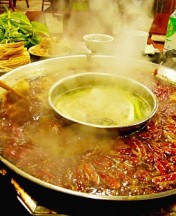
Just in case you are curious about how the authentic spicy hot pot looks like in my hometown Chongqing…..
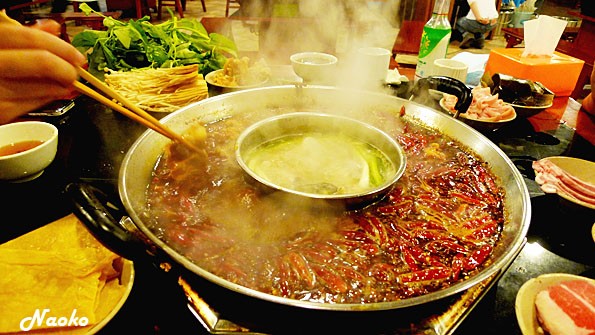
Image taken from www.dianping.com
Enjoy hot-potting!
Warning: Use of undefined constant rand - assumed 'rand' (this will throw an Error in a future version of PHP) in /home/yirese5/public_html/wp-content/themes/yireservation/single.php on line 72
Warning: Parameter 2 to wp_hide_post_Public::query_posts_join() expected to be a reference, value given in /home/yirese5/public_html/wp-includes/class-wp-hook.php on line 287
Pingback: Make Hot Pot in Your Instant Pot – Fiji Latest News
Pingback: Làm lẩu trong nồi ăn liền của bạn – Diaries Blog
Pingback: Make Hot Pot in Your Instant Pot |
Pingback: Make Hot Pot in Your Instant Pot - ShoutGh
Pingback: Make Scorching Pot in Your Immediate Pot – GoGi News
Getty Images5Real Madrid have made Chelsea pair Eden Hazard and Thibaut Courtois their top targets t.
Your recipe is dope. I have made this same recipe twice (with a couple of tweeks from what I had available) and both times it has been super good. I was first introduced to Hot Pot from some friends in ChinaTown of Boston and I have been hooked ever since. My daughter and wife love it and I was able to use your recipe to replicate our experience for my step daughter and her boyfriend. I’ve scoured the web for quite some time trying to find something simple yet authentic – your recipe has helped me achieve that! Thank you!
Hello Greg, thanks for checking out the hotpot recipe. I am so happy to hear that you and your family enjoy this spicy hotpot and it turned out to be close to what you had in Chinatown in Boston. If you enjoy simple and authentic Chinese recipes, please check out the recipe index page where you’ll find all recipes available on this site. Thanks again for the feedback! – Yi
Your recipe looks amazing! It will be so good on cold winter days now. Could you share how to make this recipe in an instant pot? Even if just the stock portion. Thank you!
Hi Emily, thanks for checking out the recipe. Unfortunately I don’t have an instant pot (yes I know I am behind) but I’d image you can easily adapt the pork stock part using instant pot. Hope this helps a bit.
My month is watering! Thank you for sharing this recipe!
I am glad to be one of the visitants on this great site (:,
regards for putting up.
Amazing things here. I am very glad to see your article.
Thank you so much and I’m taking a look ahead to
touch you. Will you please drop me a e-mail?
Any way you can take pictures of the packages you use for Sichuan Spicy Bean Paste, Chinese Black Bean, Sichuan Peppercorn so I can see what it looks like?
Hi John, I’ll take some pictures next time I am in a Chinese grocery store. In the meantime, please referred to the packages from these online listings: Sichuan spicy bean paste, Chinese black bean, Sichuan Peppercorns. Hope these pictures help.
Pingback: hinabe – ☆★☆★☆
Thankfulness to my father who stqted to me concerning this blog,
this website is in fact awesome.
This is a great recipe and I highly recommend it to anyone curious to try an authentic version of Chengdu’s convivial classic. I love that this recipe doesn’t oversimplify the ingredients that go into the complex base. So many English-language versions do. I always thought it was because Asian stores here didn’t stock the above ingredients, but a quick visit to our local Chinese market and I was able to find all of these ingredients. We also added a bit of orange zest to ours as I’ve read some bases use dried tangerine peel. Anyway, loved this. Didn’t realize it was so easy to make. I will be gifting my ready-made broth packages – no need now!
Hi Christine, thank you for taking the time to provide your feedback. I know it sounds daunting (even to local Chinese) to make your Sichuan spicy hot pot from scratch but if you access to a Chinese grocery store, anyone can make it at home. I also use tangerine peel sometimes and it does add a little zest to the broth. Again, thanks for checking out my recipe. Hope you get to try some of my other Sichuan recipes as well. – Yi
Pingback: Top 10 Spiciest Foods in the World | castimes
Yi; I love Sichuan Spicy Hot Pot so much, I’m glad I found your blog so I can make authentic Sichuan cuisine myself.
Hi Tim, thanks for checking out my blog. Please let me know if you have any questions. Yi
Hi Yi, what kind of aged spice paste do 辣妹子 restaurant use?
Hi Brandon, thanks for visiting. I have not been to 辣妹子. Is it an authentic Sichuanese restaurant? If that’s the case, my guess is that they make their aged spice/oil in a similar process with their own secret spices. I hope this answers your question.
WOW just what I was searching for. Came here by searching for hot pot
Thanks. Hope you get to try the recipe!
Hi
what can l use instead of sand ginger
Alan
Unfortunately there isn’t a perfect substitute. You can simply skip and add slightly more ginger roots. Hope this helps.
Hi Y
I made the hotpot as per your recipe last night and I had about eight guests round and they were amazed with the flavor , I had made some fish balls and with the infusion of the hot sauce everybody was blown away , I also made a pork broth and a seafood broth so they had plenty of variety and as you said being gathered round the table everybody was standing but the conversation was flowing as they cooked and eat . and plenty of variation from seafood to beef , duck pork and chicken and lots of vegetables , it reminded me of my visits to Chong Ching Thank you so much for sharing the recipe
Hello Alan, thanks for the feedback. I am so glad to hear that everyone liked the hotpot. It sounds like you and your guests had a lot of fun! Speaking of that I should make some hotpot soon too. Thanks again for visiting my blog!
I am so looking forward to making this as I loved the sauce when in Chongghing I love Chinese food and Yi thank you for sharing
Hello Alan, thanks for checking out the recipe. I hope you find this site useful!
Hi. I forgot to ask you earlier, when you make the vegetarian broth, what is the ratio of tomatoes, onions, carrots and celery that you use? Is the amount of vegetables for the broth the same as the amount of bones used in the non-vegetarian broth, i.e. 2 lb?
Also, do you use the ginger, scallions and bay leaves when making the vegetarian broth?
Sorry for asking so many questions. I’m just so excited about making this! 🙂
Hi Bjarni, thanks for the question and sorry for getting back to you late. I normally don’t really have a precise measurement of the amount of vegetables used in my stock but I’d say 2-3 lb of vegetables with the same amount of water should yield decent stock. Hope this helps.
Thanks so much for the fantastic hot pot recipes and tips! Could you help me with the ingredients and quantities to use for the peanut butter sesame sauce please?
Hello, and thanks for this amazing recipe! I hope I will get the opportunity to try it one day. 🙂
However, do you know of any ways to make the broth vegetarian? I have some friends who are vegetarian and it would be unfortunate for them and other people who are vegetarian to not get the opportunity to try this great dish.
Best wishes,
Bjarni
Bjarni
Hi there, thanks for visiting. To make the broth vegetarian, you can substitute the beef/pork/chicken stock with vegetable stock. I normally make my vegetable stock using celebrate, carrots, tomatoes, and onion but free feel to use your own version. Hope this helps!
When you say celebrate, do yu mean celery? 🙂
Anyways, thank you so much for your help! 🙂
I forgot to ask you earlier, but what ratio of celery, carrots, tomatoes and onions do you use when making a vegetarian broth? Is the amount of vegetables you use the same as the amount of bones used in the non-vegetarian recipe, i.e. 2 lb?
Also, do you include the bay leaves, scallions and ginger when making it?
Sorry for asking so many questions. I’m just so excited about making this, hahahaha. 🙂
Hi there, You’ve done an incredible job. I’ll certainly digg it and personally suggest to my
friends. I’m confident they’ll be benefited from this web
site.
Took another look – it does NOT look like it’s galangal. Good to find out 🙂
Apparently sand ginger is dried galangal? Will go shopping to make hot pot tomorrow, thank you 🙂
Pingback: sichuan hotpot recipe
Hey,
i was looking for a huo guo recipe from Sichuan, and this seems to be the right thing. I have already all ingredients expect the Sichuan bean paste. Could you give me some detailed information (and maybe a chinese name) about the paste? The only thing i can find is Chilli oil with fermented beans or do ban djian which isnt right i thing. Can i maybe use Har Har hot bean paste?
thank you!
Hi there, dou ban jian is actually the same as sichuan bean paste (just one way to translate it). Har Har hot bean paste should work as well but if you can get pixian doubanjian than you should definitely use that instead. Please let me know if you have any other questions.
Hey,
thank you again. First i was a little bit confused, because my doubanjian is from Lee Kum Kee, which looks different than yours on the picture and it seems to be a poor version of the real pixian douban, which i finally found at my asian supermarket yesterday 😀 . My first try with the Lee Kum Kee doubanjian tastes good and smells very original like in Sichuan, but not as spicy, hot an “ma” like i´ve ate it in chengdu last time. Now i will try the pixian douban. Should i put more sichuan pepper and chilli in the aged paste? Last question. Do you know if chinese chefs put MSG to their paste?
thanks again for this great recipe!!!
Wouldn’t it be better to ground most of the spices or make a spice stock first (or put in a muslin cloth) otherwise you will get all those dangerous wooded elements alongside the meat (or whatever you decide to boil and eat). I can’t say I’ve ever noticed whole spices in my hotpot besides the Sichuan pepper and chillies, so again I think most of it is ground or made into a stock at some point in the preparation.
I think some restaurants also add cumin either included in the spices or as separate seasoning?
Anyone know what the “fishy” hoisin style sauce is they use at some restaurants?
HI there, thanks for checking out my blog. You are right. When i make a large patch of spicy sauce I grind all my spices and stuff the ground spices in a spice bag. For a quick homemade hotpot I am just too lazy to grind all the spices :). And yes a small dose of cumin can be added, it’s all about the personal preference. I am not sure if I know this fishy hosin style sauce. Do you happen to have a picture or the Chinese name for it?
Water is your organic cleaner so you should always be effectively moisturized.
Interestingly enough, pictures of her as a younger woman show that she’s
adorable, and post surgery she is just beautiful. Furthermore,
you need to really feel comfortable with
the plastic surgeon you decide on.
An interesting discussion is worth comment. I believe that you ought to publish more about this
topic, it may not be a taboo matter but usually
folks don’t talk about such topics. To the next!
Kind regards!!
You should find many salons that offer tanning service. Vitamin D is a hormone-like substance critical for
the vast majority of your biological functions, including:
. If I ever found a product that was sticky or smelly I would
never use it again, but then I started hearing more and more about another issue –
dangerous personal care products so I started
researching.
She said that just that day, a teacher had asked her sixth-grade daughter to pull
her pants out of her boots and over the top so the teacher could tell they weren’t leggings.
Organic farmers must follow specific guidelines
to become certified. Make sure you stand, lie or
sit still whilst you are doing pelvic floor exercises.
I can’t wait to try this! I went to my local Chinese grocery store but no one had a clue what I was taking about when I asked about sand ginger and black cardamon. I was able to find the black cardamon and showed her. She knew it by the Chinese writing, but I had no luck with the sand ginger :(. The lady kept giving me ginger. I tried to look it up to see the Chinese name but I had no luck. Do you happen to know it?
Hi Elee, sorry for getting back to you late. The Chinese name is 沙薑 or 山柰. Here is a link to additional information: http://en.wikipedia.org/wiki/Kaempferia_galanga
Please let me know if this helps.
What you’re looking for is called Galangal in a lot of areas.
Hello,
I spent 2 weeks in China in 2008 adopting my son. He is from the province of Chongqing. We had wonderful hotpot there & I’d love to try your recipe. I live in southern CA, but I have no idea where to purchase the ingredients. Are they common to Asian markets, or is there an online market where I could order?
Thanks,
Nina
Hi Nina, thanks for checking out my blog! Yes you should be able to find most of the spices and condiments in your local Chinese supermarket especially at big chains. I hope you get to make this!!
Go to 99 ranches market, sanh phat supermarket…. come to San Gabriel valley they have the best Sichuan hot pot in town.
Wow fantastic detailed tasty recipe and clear instructions. Success in making my hot pot… and will make again and again. All the way from Northern Ireland. .. keep up the great work and thanks so much for sharing: -)
Hello Donna, thanks for visiting my blog. I am so happy to hear that you love the hot pot recipe! Hope you’ll find some other recipes on this site interesting to you as well. Thanks again!
Well, first of all thank you for sharing that recipe. Unfortunately, i’ve got problems getting hold of sand ginger here in Germany. Any recommendations for a more “common” subsitute, or is that particular spice substantial to the flavour?
All the best!
Hi Mosaik, sorry for the delay. Unfortunately there is no real substitute to the sand ginger as it’s kind of unique. I’d suggest you skip sand ginger and use additional regular ginger anise star to make up the flavor. I hope this helps! Thanks for visiting!
Pingback: Weekly Menu Saturday 10th May 2014 | not for coco
Pingback: Weekly Menu Saturday 3rd May 2014 | not for coco
Hey There. I found your blog using msn. This is a really well written
article. I will make sure to bookmark it and come back to read more of your useful info.
Thanks for the post. I will definitely comeback.
Hi, I do think this is an excellent web site.
I stumbledupon it 😉 I’m going to come back once again since i have bookmarked
it. Money and freedom is the best way to change,
may you be rich and continue to help other people.
Hi Yi, any recommendations for your fav Sichuan restaurants in NYC and if you do, any fav dishes to order?
Thank you so much your recipe, it’s 1am and I can’t sleep thinking about where to gather the ingredients to try it tomorrow LOL. I just had sichuan hotspot at Famous Sichuan on Pell St in Chinatown and it was so yummy!!! What kind of fish fillet do you use? Chilli fish is popular in Sichuan restuarants, but I think they use baking soda mayb to expand the fish.
Hello Cindi, thanks for visiting my blog. It’s been sometime since I ate at a Sichuan restaurant here in NYC but some of my favorite Sichuan restaurants are Legend and Szechuan Gourmet. However please take my suggestions with a grain of salt as my last visit to both of these two restaurants were almost one year ago. If you have the means to travel to Flushing, Queens, I do have a few other recommendations. Especially on restaurants specializing in hotpot.
For chili fish, a lot of the restaurants use carp fillet but when make it at home I use either cod or sole fillets. Both fish are tender and delicious with the chili sauce.
I hope this helps and please let me know if you have any other questions 🙂
hi
Pingback: Qiuck Sichuan Spicy Hot Pot 快速麻辣火鍋 | Yi Reservation
stumbled across this recipe and i got sent back to china… thanks so much for throwing this up for me, i’ve been looking for this recipe for ages! a few questions though… where can i find “sand ginger”? Is the licorice, the same sort of licorice they sell in coins (the sticky black stuff)? And finally, the sichuan spicy bean paste. is that the stuff they sell with chili and fermented beans in it?
Hello Jace, thanks for checking out the hotpot recipe! I am actually hosting a hotpot party tomorrow woohoo!! Now onto your questions. 1) the sand ginger is also known as Kaempferia galanga . I’ve mentioned the sand ginger with a picture in this recipe. 2) yes the spicy bean past i the spicy chili bean paste which is very common in Sichuan, China. I hope this helps and please feel free to let me know if you have any other questions. Thanks again for visiting!
Hi Yi,
This is my first time visiting your blog . I was trying to find the Chinese
hot pot recipe and found you. Last night we had a Christmas party at
our home and I also first time cooked hot pot. But everybody loves the hot
pot so much, they said it was even better than restaurants out there. Thanks
you so much for your recipe.
Hi Lin, first of all thank you very much for the feedback. I am so happy to hear that you an d your party loved this hot pot. And I think it’s such a great idea to serve hot pot during holiday season! Thanks again for your comment and I hope to see you around!
Hi there,
it looks like your recipe is the most authentic because you are a local chonqing person. I was there and had my first mala hot pot experience in a chain restaurant there, it might not have been the best restaurant but for me it was heaven. I had brains as one of the ingredients and it was soft and buttery and all that delicious heat and mala flavour, wow wow wow! We all went back to that place a few times. Now here comes my questions. of the types of chilli used in chongqing hotpot over chengdu hotpot, i heard people prefer an even spicier one from yunnan called xiao mi jiao over chao tian jiao is this true? I have seen two types of sichuan pepper also one is green and sort of in bunches and one is red/pink what is used in chongqing hotpot? Also isnt lard more commonly used in hotpot? Is sand ginger the same as dried galangal or dried kencur? Is there an even spicier recipe that you are all talking about that is the one I am after, my experience was with a hot and numbing huo guo. I hope you can help 🙂 im very keen to make as authentic as possible Chongqing hotpot here in the UK.
hi Luke, first of all thank you for visiting my blog. i am really impressed by how much you know about sichuan food. You probably know more about spicy hot pot than any average non-cooking chongqing local:) Anyway, back to cooking. Regarding the types of chilli to use, there has always been debates. For me, I use a combination of a few dried chilies and fresh chilies I can get my hands on here in NYC. If you have the luxury of sourcing xiao mi jao, do use it because it is truly spicy. In terms of sichuan peppercorn, I always prefer the green variety as it has this awesome aroma i can’t even describe. Also use a lot of green sichuan peppercorn to distinguish this from chengdu hot pot! Sand ginger is the dried kencur. In terms of oil/fat, the classic chongqing hot pot (lao huo guo) uses rendered beef fat as the sole source of fat. It is rich and delicious but no longer fits the modern health-conscious crowd. The new trend is to reduce the fat but use more vegetable oil. I hope this helps answer some of your questions and feel free to drop me a line if you have more questions. Please do let me know how it came out if you got to make this in UK 🙂
Pingback: sichuan hot pot recipe | FUDGEYJOY
Hi, glad to come across your website and this wonderful hot pot recipe. Do you have mala xiangguo recipe? I tried it shanghai and love it so much, but couldn’t find the recipe or at least on English website. Is it a Sichuan food or Beijing food by the way? Thanks.
Hi Ame, thanks for checking out the hot pot recipe. Mala Xiangguo is a popular stir fried dish across all regions of China in recent years. Judging by the name of the dish, I believe it is a Sichuan dish as mala stands for chili spicy and sichuan peppercorn spicy. I will post a recipe sometime soon when get of my current crazy schedule. Thanks
Hey!
Can you please check your crazy schedule again?? I’m also dying for some mala xiangguo…!!
hi Mazzel, sorry it took me a while to get back on blogging but i am going to resume this week. Will let you know when the mala xiangguo is posted. Thanks again for following up.
Hi Yi! I love your site and this hot pot recipe. Made it on a camping trip in the middle of the australian bush. Please let me know when you have a mala xiangguo recipe up. Its one of my favourites. Thanks heaps, Hannah
yes, the male xiangguo is really nice. i think it uses a lot of the ingredients from your hotpot as you can taste it when they fry it, problem is that chefs get lazy and you dont get the fragrance from the xiangguo, it should not be just insanely hot. so i am hoping to cook this dish at home. chicken xiangguo in crystal jade hotpot in zhong shan mall is quite good but again same problem, quality is inconsistent. you drizzle the sauce over steaming rice … heavenly! so yes please, can you experiment on xiangguo and let us know … ppppplllllllleeeeeeeaaaassssseeeeee….
Hi Jessica, thanks for your visit and taking the time to echo the others on male xiangguo. I am currently working on putting together a solid recipe but i promise it will be here soon! Thanks for the patience and I hope to see you around! Thanks again!
Pingback: Meal Plan #2 | Lorien Mahay
Hi Yi,
Thanks for this wonderful & easy to understand recipe. Was craving for 麻辣火锅 & came across your post while searching for the soup base. Couldn’t find ready made paste over at the super mart here so I got all the raw ingredients & start to cook from scratch. Without this recipe, I think I would not be able to get it done. Now that am done with it, gonna enjoy my 麻辣火锅 with my parents tonight!! THANKS!!!
Hello Victor, first of all thank you for being a fan of spicy hot pot!! I know a lot of people can’t understand the concept of hot pot especially the super spicy version! I am glad that you were able to make the base following the recipe. Please let me know how you liked it!
Yi
Ah… I miss real Chinese food! After living in china for 2 years it’s really difficult to eat the American style Chinese food. My wife and I, who’s from Henan province, can’t wait to make this. The hot pot we had in Chongqing is definitely one of my favorite things to eat. Thank you so much 😀 If you have a Suan Cai Yu recipe please share it!
Hello Scott, thank you for checking out my blog. I am so happy to hear that you love Chongqing hot pot! I actually just had Henan food recently here in NYC. I absolutely loved it! My friends and I sampled several kinds good noodles, appetizers, and Chinese stewed pork burger. Everything was delicious! Yes I make Susan Cai Yu at home and will definitely post a recipe shortly. Thanks again for dropping by!
Hi Yi! I hope it’s not too late to join in this discussion, but I am trying to find out what the difference is, if any, between Sichuan/Chengdu hot pot and Chongqing hot pot. I think your expertise and experience could enlighten me!
hello Rae, it’s never too late to join the chat. In fact your question is so brilliant that I can probably write a 2 page paper on it. And I am quite surprised that this question comes from someone that’s of Sichuan origin.
Without going into the cultural history, the main difference between hot pot in Chongqing and hot pot in Chengdu is that the former one is even more spicy and heavily spiced than the latter. In general, you’ll find more Sichuan peppercorns and dry chili in the Chongqing hot pot than that of Chengdu. Another difference is in terms of presentation. Chongqing hot pot is very straightforward with little thoughts in presentation. On the other hand, hot pot in Chengdu might come with more thoughtful presentation and even better service.
I am curious to hear about your hot pot story. What’s your experience with Sichuan/Chongqing hot pot?
Yi
Since I am from Chongqing I am naturally biased towards the Chongqing style but I also enjoy the Chingdu style a lot.
Some of the Chengdu hotpots are using Green Peppercorns too!
yup agreed…I love how the green peppercorns taste…unfortunately I have not seen any fresh green peppercorns in the US so far 🙁
In London the green peppercorns are now quite widely available from Thai supermarkets, and also stocked in our main Chinatown supermarkets. Vietnamese supermarkets have them picked in a jar, but it’s obviously not as good as fresh. Also, we are lucky to have Sichuan Peppercorn imported from Sichuan province for the first time in over 5 years alongside the more burnt and bitter Guangdong variety. A few supermarkets also stock the green Sichuan peppercorn (not be confused with normal fresh green peppercorn or the dried red Sichuan peppercorn), but that’s slightly harder to come across.
yup the green sichuan peppercorn has a pungent (in a good way) flavor that I love so much. I can find dried green sichuan peppercorn here in nyc as well but still yet to see fresh green sichuan peppercorn which is abundant in my hometown chongqing.
Pingback: Clear Soup Chinese Hot Pot | Yi Reservation
Hi Yi how are you? I would like to know, what’s the recipe for the non spicy broth. Thanks =)
Hi Xingyi, i will post the clear both shortly (before the winter ends for sure). Thanks for stopping by.
thanks for the answer, I’ll waiting for it =)
Me too! looking forward 🙂
Hi Tanping and Xingyi, I have posted the clear soup hot pot recipe. Please check it out!
Hi! Finally got around to making hot pot, and just want to say, we made both these recipes and they came out so delicious! Thanks for bringing us a taste of home here on the west coast of California!
Hi there, thanks for the kind feedback. So glad to hear that the hotpot came out good. If you don’t mind, which broth did you like better?
Hi Tanping, thanks for the feedback and I am glad to hear that you enjoy spicy hotpot as well. What are your favorite ingredients?
Thank you so much for posting this. I have had a very nice young man from China in my college classes the last two semesters. I noticed he was quiet and maybe shy so I started talking to him. I found out that he is homesick and really misses the food. The mom and grandma in me kicked in and I started looking for something that might cheer him up and I think this might help. He is from Sichuan so I hope this is what he has been missing. Thanks again!
Hello Granny L., that’s very kind of you. When I first arrived the States I was in the same position. I missed the real Chinese food so bad I started to learn how to cook. I hope this recipe is helpful to the man from your college. Thanks for stopping by 🙂
Hi Yi,
After a tip from my collegue about Hot Pot I went Googling for a good recipe. Some didn’t. Look right, but yours caught my eye.,yesterday I made the recipe, and we loved it! Sometimes you just hit a spicy bit, and it was fun to see their faces then 🙂 overall it’s a good spice level, even for us Dutchies, who tnd to not eat spicy at all!
Thanks again for the recipe, will go explore the rest of your site now.
Tim.
Hi Tim, i am glad that you liked the recipe. I know spich hotpot is not for everybody but i am happy to hear that you and your guests enjoyed that hard kick! Please enjoy exploring the rest of the site!
How to make the special peanut butter sesame dipping sauce? I always think that is the key for hot pot but can never replicate the taste in the restaurant.
Hi June, you are right, the dipping sauce is the key to a good hotpot experience. Here is a quick recipe for the peanut butter sesame sauce:
1 combine 1tbsp of peanut butter, 2 tbsp of sesame paste, and 1 block of fermented bean curd (腐乳)
2 mix the ingredients while adding water to the mixture gradually until the sauce becomes smooth and creamy
3 mix in 1 tsp of sugar and top with some chopped cilantro
hope this helps 🙂
Thank you so much for your Hot Pot recipe. I can hardly wait to try your recipe for home made Sichuan stock. I do have a question. When I host a hot pot, chop stick-to mouth-to soup-to mouth is perfectly acceptably to the Asian guests, but not so much to the others. Is this a safe practice? I have search the web for an answer. Many say it is fine with close family and friends. But it seems to me that germs can be passed by friends and family just as much as with others. I would reallt appreciate an answer based in science. Can you help?
Hi Ron, thanks for checking out the hot pot post. I’ve been eating hot pot for as long as I can remember and I have rarely gotten sick (if i was sick it was probably due to over consumption). The consensus is that the gems will not survive the boiling stock. However, if your guest still don’t comfortable about sharing the pot you can use a pair of communal chopsticks to distribute the food so the personal chopsticks will never touch the stock. Even better, get these wire skimmers so everyone can cook without cross-contaminating. Hope this helps.
I was wondering if you could reuse the broth after using it? Freeze it possibly?
Hello Michael, to answer your question, yes you could reuse the broth. I normally reuse it once or twice after my initial use. Before you store it in the freezer, just filter the broth through a mesh drainer to remove the solids (you can keep all the spices though). Then bring the broth to boil and cool it down. Then you can good to go. Hope this helps.
Hi Yi,
I really like this recipe. Thank you so much for sharing it with us. I got a question.
If you freeze the broth and keep it for a short period of time, does it reduce the fragrant, flavour or colour of the broth? Thank in advance
Theara from Cambodia
Hi Theara, yes you can freeze the broth. It’s the best to consume all the broth at once but freezing it won’t affect the flavors too much.
Thanks for the great recipe. What kind of wine should I use and can you recommend a brand for the wine?
Hey Anita thanks for the question. I’d say any Chinese cooking wine would work. The brand I normally use is called Shaoxing Wine and it looks like this. Help it helps please let me know if you have any other questions. Thanks.
Thanks for the reply, I really appreciate it. I’ll check my local asian grocery to see if they have it. I love your blog, thanks for sharing your recipes.
you are very welcome. I am glad that you like this blog.
I had my first hot pot in Chengdu over 10 years ago, since then I have off and on searched for a recipe, none being correct, your recipe looks just right. One thing I remember was after removing your morsel from the hot pot, dipping it in the hot chili type sauce the next step was to drip it in a powdered spice mix which made it even hotter followed by bottle after bottle of peanut milk. Do you have the recipe for the powdered spice mix? Thank you so much this recipe has made my day. D. Schwartz
Hi Dot Schwartz, thanks for checking out my recipe. I am glad that you lile the authentic hotpot from Chengdu! It’s hard to find authentic Sichuan hotpot outside of Sichuan and NYC is no except so I have to do it by myself.
Regarding the dry dipping mix, I’ve had a few times with hotpot derevative dishes such as spicy chicken pot or fish pot. In general this kind of spicy mix is made from crushed dry chili, Sichuan peppercorn powder, five spice powder, fried peanut, salt, sugar, scallions, cilantro. Of course each restaurant will add their own additional ingredients to make it special. Please let me know if this sounds close to what you had? Thanks.
Perfect thank you so much.
I can’t wait to try this dish. Could you recommend a brand of the Spicy Sichuan Chili Bean Paste? As a lover of Asian food, from a non Asian family, I am unfiniliar with what brands and types of this sort of product would be the best. Any advice would be most appreciated.
Hi Michael, thanks for your visit. Depending on where you live you might encounter different brands or distribution trademarks. To answer your question I’d recommend a type of spicy bean paste called Pixian bean paste. This is the most commonly used bean pasted used in cooking Sichuan dishes. However I believe you can only find this from a Chinese grocery store. Alternatively you can also use the Lee Kum Kee brand which is more common in non-Chinese stores. Hope this helps.
Thank you for the reply. I was able to find the douban at a local Asian grocery. Very Good! Next I was wondering what type of chilis to use? I grow massive amounts of peppers so I probably have the chili but I was in aware of what type?
Hi Michael, traditionally I use dried chilli pepper however I’ve seen fresh chilli being used in some modern hot pot as well. If I had the luxury of growing peppers I’d use a mix of different kind of pepper as long as you are comfortable with the spicy level. Thanks.
Pingback: Chinese Hot Pot Part I (火鍋) – An Introduction | Yi Reservation
Yi, I am began to love your site. So many authentic Chinese recipe to try. My family is actually not fond of Chinese food (fro restaurant), maybe because we don’t have good Chinese restaurant here. After I made my first noodle soup from your recipe, they’ll demand more homemade chinese cooking now. Thanks to you!
Thanks Dewi for your kind comment. I am really happy that you find some of these recipes useful. Please let me know how it comes out if you get to try another recipe from here 🙂
Oh my husband will go crazy! He looks painful to eat super spicy food but he totally enjoys it. I grew up without much spice in the food so my stomach can’t tolerate (otherwise I would love to!). I love Chinese hot pot!!! Your detail recipe is wonderful!
thanks Nami.
absolutely love it. hot pot is the all-time best.
thanks Wei. yeah I miss the hot pot from Chongqing!
Yi, your hot pot looks great with so many variety of ingredients…and spicy…Now that the weather here is getting cold and wet this is absolutely the perfect way to go.
By the way, thanks for the help and the site is up and running after long calls and fixing…
Hope you have a great week ahead 🙂
Thanks Juliana, glad to hear the site is up and running now. Have a good weekend!
Nice to meet you, Yi! Thanks for visiting my blog. I spent quite awhile on yours. I love every dish you make here, especially ma la huo guo. It’s definitely a favorite of mine! And I never had a recipe for Kao Fu before until now! Looking forward to more sharing.
Hi Jessica, thanks for your visit. I am glad that you have found something interesting. And I love your beautiful blog as well!
I love hot pot. Looking forward to trying the spicy style. BTW, congrats on winning the competition! 🙂
Thanks Health Bee.